

Badge Holder Retractable Types, Materials, and Best Uses
At 7 a.m., a nurse taps an access card against a scanner, waits for the lock to release, and lets the badge snap back to chest level. At a trade show, an event staffer repeats the same reach across a registration table all morning. In both cases, the buying decision isn't whether people need identification. It's how that identification should hang, move, and survive the workday.
A retractable badge holder can make scanning quick and keep an ID visible, but a basic reel isn't right for every workplace. The useful questions are practical: which format handles daily pulls, which materials fit the environment, and which custom features justify their cost?
Table of Contents
- Why a Retractable Badge Holder Is on Almost Every Lanyard
- How a Retractable Badge Holder Actually Works
- Main Retractable Badge Holder Formats Compared
- Materials and Build Quality That Matter
- Customization and Branding Options
- When a Standard Retractable Reel Is the Wrong Choice
- Buying Checklist for Teams and Events
- Choosing the Right Retractable Badge Holder for You
Why a Retractable Badge Holder Is on Almost Every Lanyard
At a hospital entrance, a nurse reaches for an access reader while moving between patients. At a registration desk, an event worker repeats that motion for every visitor. A standard lanyard keeps the ID nearby, but the card can swing, twist, or catch on a door handle. A badge holder retractable keeps the credential attached and gives the wearer enough reach to present it without removing the lanyard.
That difference matters in offices, clinics, access-controlled buildings, and trade shows. A registration worker can pull a badge toward a scanner without unclipping it. A clinic employee can present identification while keeping the holder secured to a uniform. A security worker can show credentials for inspection, then release the card and return it to the same position.
Practical rule: Choose the reel around the worker's movement, not just the badge artwork.
A retractable holder also helps teams maintain visible, consistent badge placement. In regulated workplaces, that can support compliance with rules requiring identification to remain visible while on duty. California regulations for certain sectors require licensees to wear badges at all times while working and in public view. California cannabis rules also require a laminated or plastic-coated employee badge to remain displayed, with a first name, employee number, and colour photo. The requirements appear in California's badge-display regulation.
The three decisions buyers should make
- Daily durability: Conference staff may need a lighter reel, while healthcare and access-control teams need a holder built for repeated pulls.
- Environmental fit: Nylon, steel, ABS plastic, metal-detectable housings, and breakaway components address different workplace risks. Choose for cleaning routines, snag hazards, security requirements, and the weight of the credential.
- Branding value: A printed insert can suit a short event. A company with a fixed uniform may get more value from a branded strap or custom reel shell.
Attachment position can also affect compliance. California private-security rules specify that a badge may be worn only on the upper left breast of a distinctive uniform. A retractable holder helps keep the badge there while still allowing quick access. Badge rules also prohibit alteration or obstruction, and licensing violations can carry penalties such as a $250 fine per violation in several contexts. The buying lesson is direct: visibility and attachment are workplace controls, not decorative details. A cheaper reel that loosens, swings out of position, or fails after constant use can cost more through replacement, disruption, and compliance trouble.
How a Retractable Badge Holder Actually Works
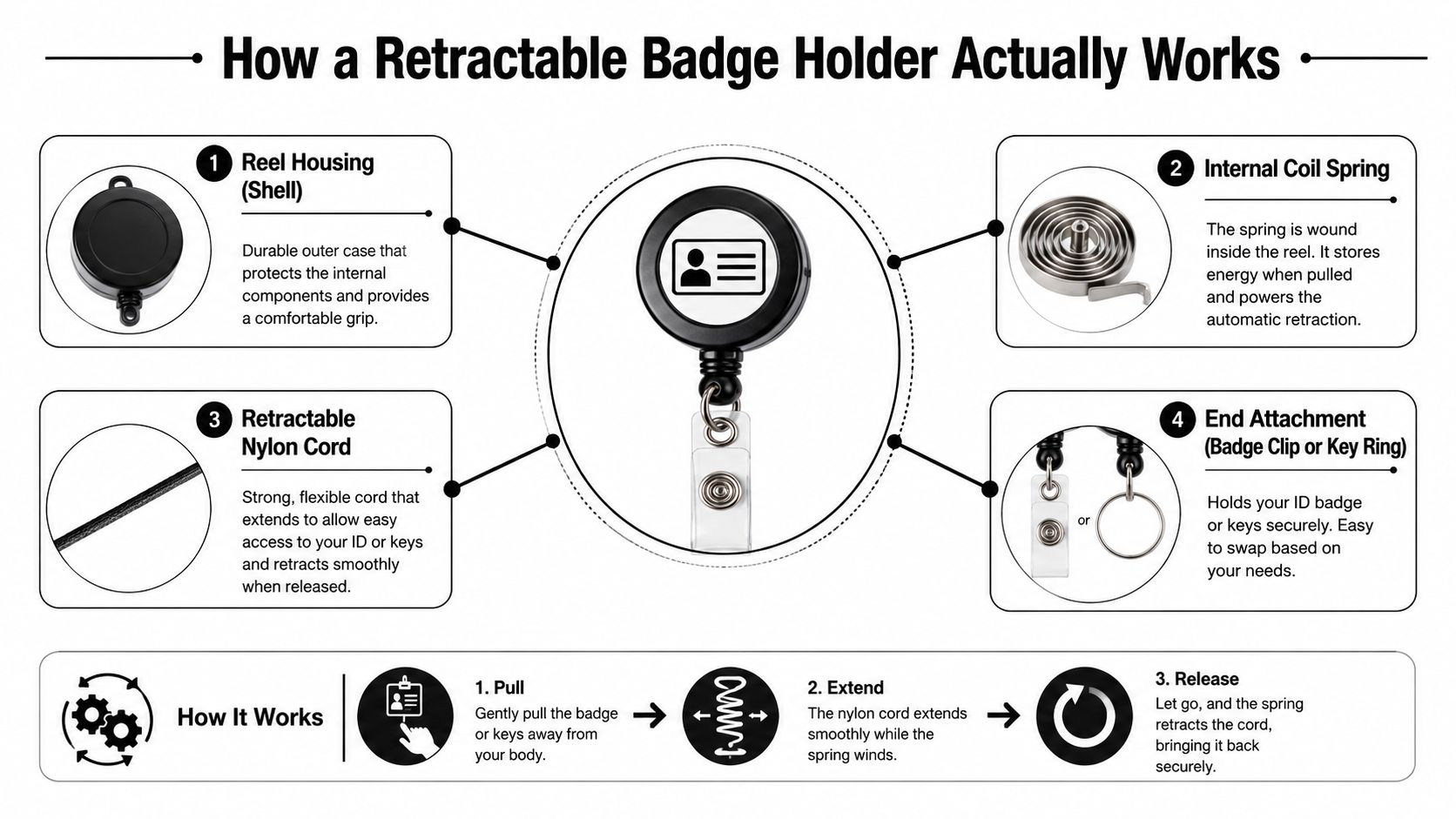
A retractable holder has four working parts. The reel housing is the outer shell, commonly made from ABS plastic or metal, and it protects the internal recoil mechanism. The cord runs from the housing to the badge, usually as braided nylon for lighter use or stranded steel when the credential and work environment demand more resistance.
At the end of the cord, the fitting connects to the ID. Common options include a swivel clip, vinyl strap with a card slot, bulldog clip, and split ring. The top of the reel then attaches to clothing or a lanyard through an alligator clip, belt-loop strap, or lobster clasp.
What happens during a pull
- The wearer extends the cord. Pulling the badge rotates the internal spool and loads the recoil spring.
- The card reaches the reader. The cord provides working distance without disconnecting the reel from the garment.
- The wearer releases tension. The spring turns the spool back, drawing the cord into the housing.
- The badge returns to position. A properly selected reel brings the card back without excessive slack or a harsh snap.
Cord reach varies by product. Canadian listings commonly specify 24 to 36 inches, with examples using 24-inch and 30-inch cords and another listing a 36-inch nylon cord, as shown in Canadian badge-holder listings. The right length depends on the reader location. Too little reach forces the user to lean or unclip the holder. Too much cord creates more opportunity for snagging.
The internal spring is the part that separates a disposable import from a serviceable workplace reel. A weak spring may fail to retract a badge consistently, while excessive tension can strain the clip, cord, or garment attachment. Buyers should judge the complete mechanism, not only the shell's appearance.
Main Retractable Badge Holder Formats Compared
A hospital access card, a warehouse credential, and a trade-show badge face different daily hazards. Choose the reel around the work, not the logo or shell colour. The wrong format creates replacement costs, lost scan time, and avoidable snag risks.
Standard plastic reels suit offices, clinics, and event credentials. They are light, easy to distribute, and appropriate when users scan occasionally and the badge is light. Use them for volume orders where the operating routine is gentle and total cost matters more than maximum durability.
Heavy-duty reels fit warehouses, manufacturing areas, security work, and teams that extend cards repeatedly during a shift. Specify a reinforced housing, a stronger attachment, and steel cable when abrasion or a heavier credential would wear through nylon. The higher purchase cost can be justified when frequent replacements would cost more.
Eco reels give organisations a lower-impact material story while retaining the retractable format. Recycled ABS, wheat-straw plastic, and PET cord options can support a sustainability brief. Confirm that the shell, clip, and spring still match the workload before approving them for constant use.
Breakaway combinations pair a reel with a lanyard that releases under sudden force. Choose this format around children, patients, moving equipment, or any workplace where a hanging credential could catch. A breakaway feature addresses a specific hazard, not a general quality concern.
| Format | Best Environment | Pull Length | Typical Cord | Price Tier |
|---|---|---|---|---|
| Standard plastic reel | Office, clinic, trade show | Short to medium | Nylon | Entry |
| Heavy-duty reel | Warehouse, manufacturing, security | Medium to long | Steel cable or reinforced nylon | Mid to premium |
| Eco reel | Events, offices, sustainability-led programmes | Short to medium | PET or nylon | Mid |
| Breakaway combination | Healthcare, visitor areas, higher snag risk | Short to medium | Nylon with breakaway lanyard | Mid to premium |
Compare badge weight, attachment style, pull frequency, and cord-catching risk before placing a team order. Compliance can also affect the attachment decision. California's repossession badge rules require an approved standard design, clear visibility, required agency information, and prohibit wearing the badge on a belt or hanging it around the neck. Violations carry fines of $100 for a first violation, $175 for a second, and $250 for each subsequent violation, as detailed in California's repossession badge statute.
For a coordinated event kit, pair credential holders with custom keychain options for event teams, so identification accessories follow the same branding and distribution plan.
Materials and Build Quality That Matter
A retractable badge holder earns its keep when the shell, cord, spring, and attachment match the workplace. ABS plastic suits offices and trade shows because it is light and cost-conscious. It is a poor choice where impact, moisture, heat, sanitation routines, or metal-detection procedures add risk.
Polycarbonate provides a tougher shell for harder daily use. Metal-detectable housings fit food-processing and certain healthcare environments where a broken fragment must be easier to identify during quality control. Choose that feature only when the site's operating procedure or audit requirements require it. Paying for a specification no one uses raises the purchase cost without reducing workplace risk.
Match the cord to the work
Braided nylon is flexible and comfortable for ordinary access cards and event badges. It gives a smooth pull when the cord is protected from sharp edges and heavy abrasion. Stainless steel cable suits warehouses, industrial areas, security routines, and credentials that put repeated stress on the mechanism.
Pull-cycle and retraction-force ratings give procurement teams a better basis for comparing heavy-duty models than the label alone. One Canadian-market reel is rated for 10,000 pulls at about 6 ounces of retraction force, while another premium model claims 100,000 pulls, according to heavy-duty badge-reel guidance from Specialist ID. Treat those figures as comparison points, not a promise that every workplace will produce the same result. Frequent scanning, abrasive clothing, and rough handling shorten service life.
| Environment | Shell Material | Cord Type | Strap End |
|---|---|---|---|
| Office | ABS plastic | Braided nylon | Vinyl strap or swivel clip |
| Trade show | ABS or recycled plastic | Nylon or PET | Card slot strap |
| Healthcare | Metal-detectable or durable plastic | Nylon, selected for hygiene needs | Breakaway lanyard or secure strap |
| Warehouse | Polycarbonate or reinforced housing | Stainless steel cable | Carabiner or strong clip |
| Food processing | Metal-detectable housing | Suitable detectable or reinforced cord | Detectable strap end |
Approve samples only after checking the failure points. Spring fatigue appears as slow or incomplete retraction. A weak clip weld can detach the holder from clothing, while UV exposure can make some plastics brittle. Moisture and cleaning chemicals may also wear down printed surfaces or strap materials.
A reel that looks good but fails at the clip creates replacement work, access delays, and another purchasing cycle. Check the badge weight, attachment style, pull frequency, and cord-catching risk before committing to a team order. That is how build quality becomes a cost and safety decision, rather than a packaging claim.
Customization and Branding Options
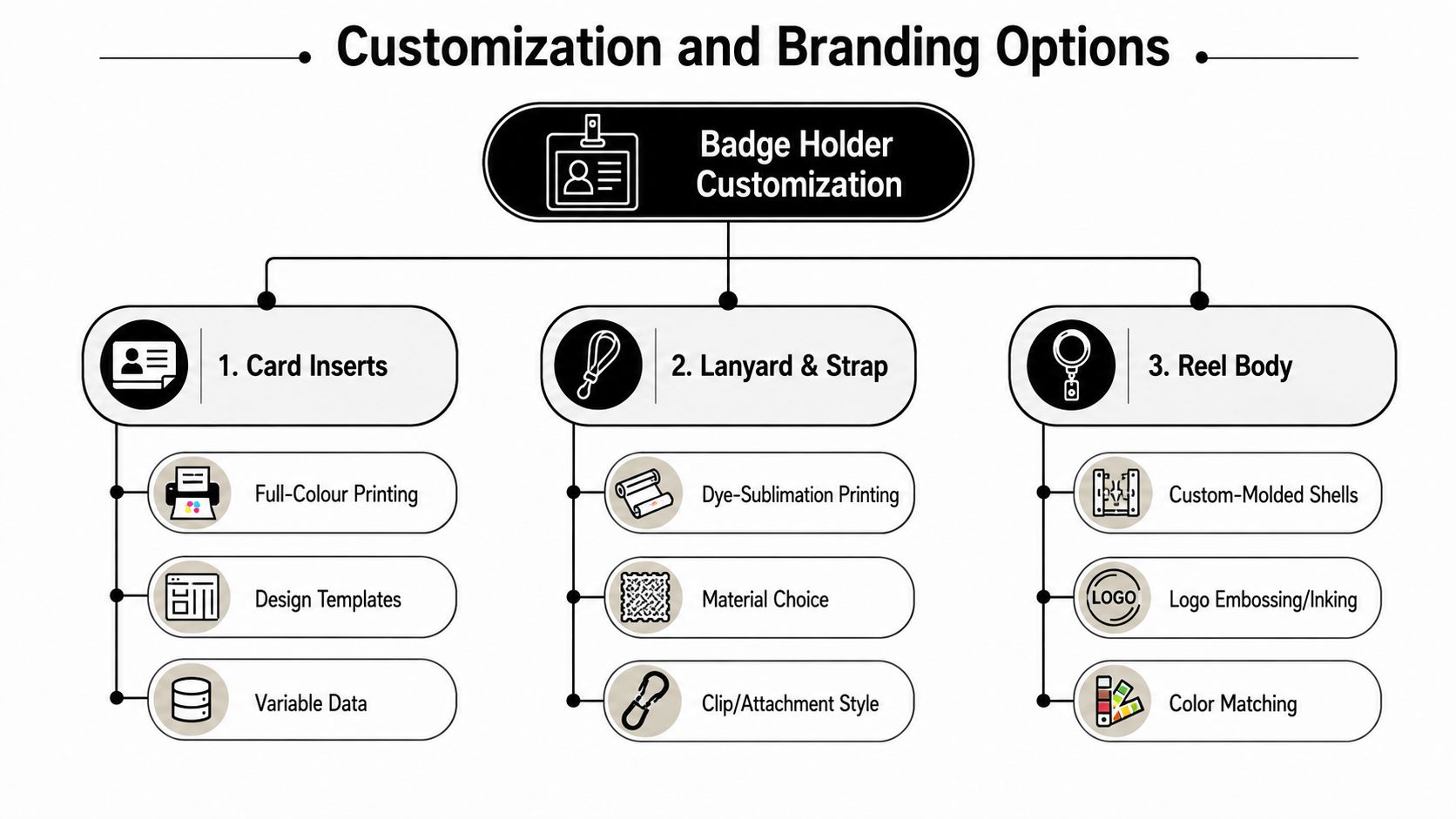
Choose the branding surface according to the workplace risk, replacement cycle, and compliance pressure. A full-colour card insert carries the employee name, photo, department, event role, sponsor message, or access identifier. It suits trade shows and temporary teams because the reel remains in service while credentials change, reducing discarded hardware and reordering.
A dye-sublimated lanyard provides a larger visible branding area before anyone reads the card. Corporate teams can repeat a logo pattern, while event organisers can print the event name and sponsor marks. Back-side printing carries a website, phone number, or short instruction without crowding the front. Use a strap that stays readable and cleanable in the work environment, especially where badges face frequent handling or cleaning.
Custom-moulded reel shells give a programme a physical identity. Logo moulding, embossing, inking, and colour matching make sense for established teams ordering replenishments, not for a one-off event. A custom shell also creates a longer replacement cycle, so approve the material, clip, and print finish together rather than judging appearance alone.
Pick the upgrade that solves a real problem
- Variable card data: Use sequential names, numbers, departments, or access identifiers when the card controls identification or permissions.
- Branded straps: Choose them when staff need a visible, consistent identity system across an office, hospital, or event floor.
- Custom reel bodies: Reserve them for stable programmes where repeated replenishment justifies the setup and approval work.
- Retail-ready packaging: Poly bags, header cards, and gift boxes fit promotional distribution and retail packs. Bulk internal orders usually need simpler packaging and lower handling cost.
Minimum order quantities and lead times depend on the decoration method and product. A quick-turn event usually gets better value from blank reels with printed inserts. A corporate rebrand can justify custom straps, provided artwork approval happens before production and delivery deadlines.
For coordinated accessories, branding packages from Power Print help align badge holders with other printed and decorated items. Review artwork at full size, confirm colours, and request a physical or digital mockup before production. That approval step catches unreadable text and poor contrast before the order becomes replacement stock.
When a Standard Retractable Reel Is the Wrong Choice
A standard retractable reel earns its place in offices and event settings, but a workplace hazard changes the decision. Around rotating machinery, conveyors, and exposed moving parts, its cord can snag. A fixed holder or breakaway lanyard creates less risk. Workers wearing gloves or layered protective clothing may also find that a small garment clip shifts or becomes difficult to operate.
Sterile zones create another concern. A swinging badge can touch surfaces, clothing, or equipment, while a retractable mechanism takes more effort to clean thoroughly than a simple strap. In operating theatres, cleanrooms, and controlled production areas, choose a static, cleanable holder or the site-approved credential system.
Use the safer format for the hazard
- Heavy machinery: Choose a breakaway lanyard or another site-approved fixed ID method. Keep cords away from moving parts.
- Sterile zones: Use a static, cleanable strap or a single-use badge process where infection-control or contamination procedures require it.
- Hard-hat sites: Specify a helmet-compatible clip or mount. A regular shirt clip does not reliably keep the badge accessible on protective equipment.
- Visitor-heavy events: Give visitors visible photo ID and use a controlled return process. Staff may benefit from reels, but visitors do not automatically need them.
Safety decision: As snag, contamination, or PPE-compatibility risks increase, a standard retractable reel becomes a poorer choice.
Badge visibility can also carry regulatory weight. California cardroom and related licensee provisions require workers to wear badges while on duty and surrender expired or invalidated badges within 30 calendar days. The broader lesson is clear: credential issuance, display, and return need a controlled process, not just a convenient attachment. For security-focused accessories, compare security merchandise options, then have the workplace safety lead approve the attachment.
A lower purchase price does not offset repeated failures, cleaning problems, or a badge that disappears under protective gear. Choose the format that fits the hazard first, then compare reel durability and replacement costs.
Buying Checklist for Teams and Events
Procurement teams should treat a retractable holder as a small piece of equipment, not an afterthought. The cheapest unit may look attractive until staff spend time replacing broken clips, reissuing damaged cards, or sorting inconsistent accessories.
Before ordering, confirm these points:
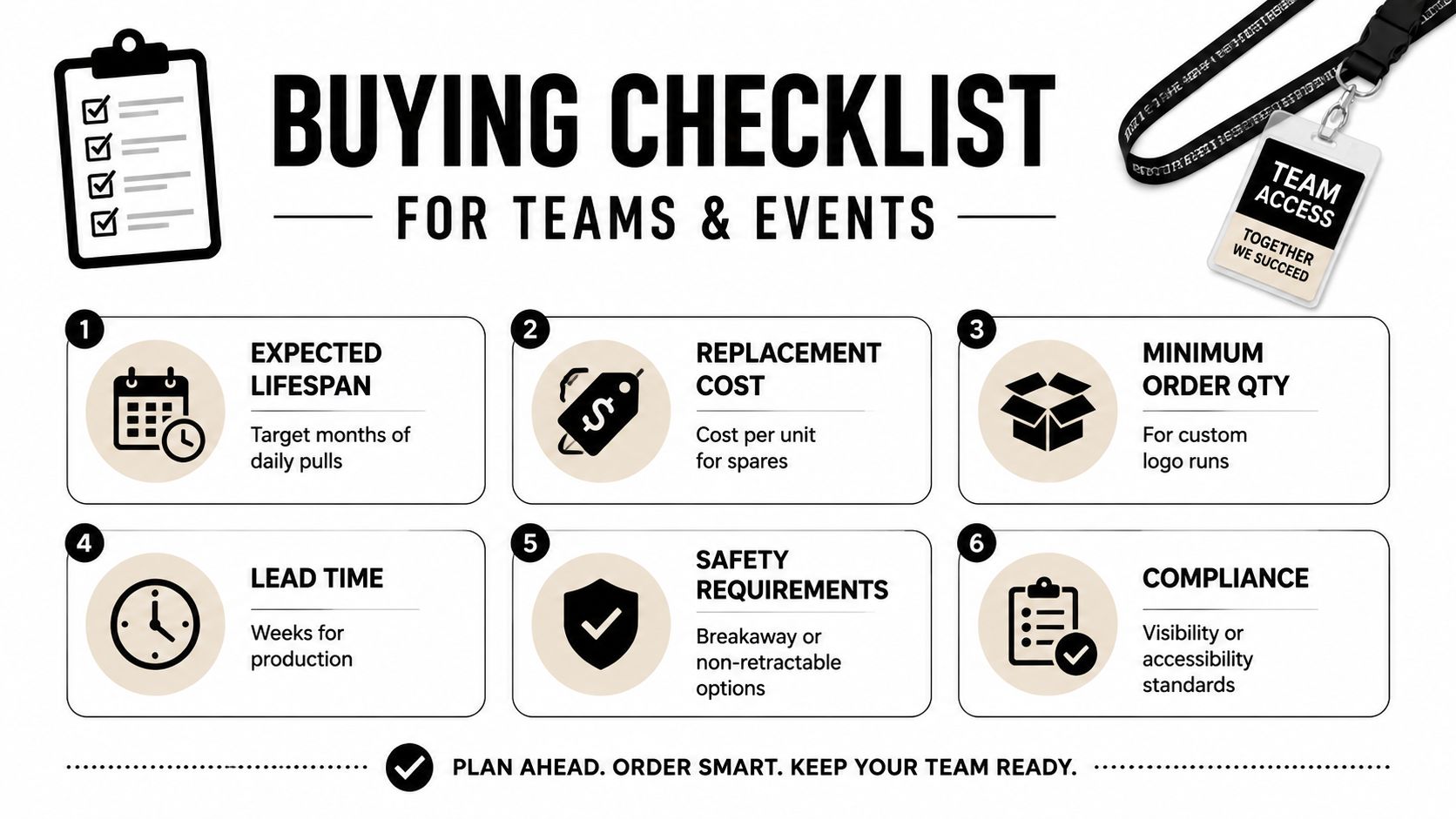
- Expected lifespan: Define how many months of daily pulls the holder must support, then ask for pull-cycle information where frequent scanning is expected.
- Replacement cost: Price spare reels, not only the initial order. A planned replacement stock prevents one failed clip from disrupting a shift or event desk.
- Minimum order quantity: Separate blank-stock needs from custom logo runs. A small pilot may need standard reels and printed inserts rather than a fully custom shell.
- Lead time: Branded straps, moulded bodies, and retail packaging require more planning than generic inventory.
- Safety format: Confirm whether the site requires a breakaway lanyard, detectable material, hard-hat attachment, or a non-retractable holder.
- Compliance: Check badge visibility, placement, photo requirements, and access rules before choosing the attachment.
The three checks buyers most often skip are simple. Verify that the clip fits the existing card holder. Confirm that the cord reaches the scanner, turnstile, or inspection point without forcing a stretch. Test printed surfaces against the products users handle, including hand sanitiser and sunscreen.
Ask for samples before committing to a large programme. Pull the cord repeatedly, attach the holder to the uniform, and inspect whether the badge returns to the required position. If the organisation also orders lanyards, cards, signage, or apparel, consolidating production with one printer can reduce freight coordination and keep colours consistent.
Choosing the Right Retractable Badge Holder for You
The right holder depends on the consequence of failure. An office worker with a light access card needs a dependable, mid-weight reel. A warehouse worker moving through a demanding environment needs a reinforced body, steel cord, and a stronger attachment. A healthcare team may need metal-detectable components, a breakaway lanyard, or a fixed holder instead of a conventional reel.
Trade shows have different priorities. Fast badge turnover, clear names, sponsor visibility, and simple replenishment usually matter more than an industrial pull-cycle rating. An eco reel with a full-colour insert can make sense when the event wants a lower-impact material story and the credential won't face severe abrasion.
| Scenario | Reel Format | Cord Material | Clip Type | Customization Lever |
|---|---|---|---|---|
| Office access | Mid-weight standard reel | Braided nylon | Alligator clip | Logo strap |
| Hospital or clinic | Breakaway combination or approved secure holder | Nylon or site-approved detectable option | Breakaway attachment | Photo card insert |
| Construction site | Heavy-duty reel or helmet-compatible system | Stainless steel cable where appropriate | Carabiner or helmet clip | High-visibility identifier |
| Warehouse | Heavy-duty reel | Steel cable | Strong clip or carabiner | Sequential numbering |
| Trade show | Standard or eco reel | Nylon or PET | Card-slot strap | Full-colour insert |
| Sterile area | Static strap-only holder | Cleanable approved material | Secure fixed attachment | Simple printed ID |
The central trade-off is clear: higher snag or hygiene risk demands safer components, even when they cost more per unit. A damaged credential, failed attachment, or unsafe lanyard creates more trouble than the small saving from choosing the lightest generic reel.
Canadian product content often promotes convenience without helping buyers decide when a reel should be avoided. Make that decision before you request artwork. Choose the environment first, then select the cord, shell, attachment, and branding method around it.
A sample pack or quote request is the sensible next step. Test the holder on your uniform, at your scanner, under your cleaning and movement conditions, before standardising the purchase.
Power Print can help Vancouver teams coordinate badge holders, printed inserts, branded lanyards, apparel, signage, and event merchandise through one local supplier. Visit Power Print to request a quote or mockup, and test the right retractable holder format before placing a full order.