

Custom T Shirts: A Buyer's Guide for Canadian Businesses
Canada's custom t-shirt printing market generated US$114.4 million in 2023 and is projected to reach US$210.1 million by 2030, but the right choice still depends on the job. Choose screen printing for large, durable runs, DTG for detailed, low-quantity orders, and a local Canadian vendor when dependable delivery matters.
Why do so many businesses start with an online template before asking the more important question, what must these shirts do in real life? A trade-show giveaway, a landscaping crew's work uniform, and a one-off staff shirt may all say “custom t shirts,” but they need different garments, decoration methods, approval processes, and delivery plans.
I've helped Vancouver businesses make that decision, and my advice is consistent. Don't choose a printer because the website looks convenient. Choose the production method and local partner that protect your deadline, your brand colours, and the likelihood that people will wear the shirt.
Table of Contents
- Why Your Choice of Custom Apparel Matters
- Comparing Screen Printing, DTG, and Vinyl Methods
- Selecting the Right Fabric and Fit for Your Team
- Understanding Costs, Minimums, and Turnaround Times
- A Step-by-Step Workflow for Local Ordering
- The Advantages of Working with a Local Vancouver Provider
Why Your Choice of Custom Apparel Matters
A business owner ordering branded apparel can quickly get buried in online templates, garment colours, print locations, and competing quotes. One marketplace offers a low price, another promises speed, and a third shows hundreds of styles. The decision feels creative, but the expensive mistakes usually come from production details, not from the logo itself.
A shirt represents your business after the event ends. If the fabric feels uncomfortable, staff may avoid wearing it. If the print cracks, fades, or lands in the wrong position, customers notice the inconsistency. If the shipment arrives after the conference, grand opening, or outdoor campaign, a low unit price won't rescue the project.

Treat the shirt as a business asset
Canada's custom t-shirt printing market was valued at US$114.4 million in 2023 and is projected to reach US$210.1 million by 2030, with a 9.1% CAGR projected from 2024 to 2030, according to Grand View Research's Canada market outlook. The same source identifies screen printing as the largest revenue-generating technique in 2023 and digital printing as the fastest-growing segment.
That distinction matters locally. Screen printing remains suited to established, repeatable bulk work, while digital production gives businesses more flexibility for detailed designs and smaller runs. Custom t-shirts sit within a wider Canadian branded-apparel market that includes hoodies, polos, workwear, and uniforms. A Canada custom apparel market estimate places that broader sector at US$70.25 million in 2024, with a projection of US$122.16 million by 2032 at a 7.16% CAGR.
Practical rule: Approve the garment and decoration method with the same care you give the artwork. Your logo can be perfect and still produce a poor result on the wrong shirt.
The best order starts with the use case. Ask whether the shirts will be washed repeatedly, worn outdoors, handed to customers, used for a single promotion, or reordered as part of an ongoing uniform program. Once those answers are clear, the choice between screen printing, DTG, and vinyl becomes much easier.
Comparing Screen Printing, DTG, and Vinyl Methods
The three methods serve different jobs. Screen printing deposits ink through prepared screens, DTG sprays ink directly onto the garment, and vinyl uses a cut or printed film applied with heat. None is universally superior, and a printer that recommends one process for every order is simplifying the decision too aggressively.
| Method | Best For | Durability |
|---|---|---|
| Screen printing | Bulk team shirts, uniforms, events, and bold logos | Excellent when the artwork, ink, and garment are properly matched |
| DTG | One-offs, small batches, photographs, gradients, and detailed artwork | Good for suitable garments, with results influenced by fabric and care |
| Vinyl application | Simple graphics, names, numbers, and small batches | Strong for straightforward applications, though edges and film feel differ from ink |
Screen printing
Screen printing is my default recommendation for a large run with a bold design. Each ink colour is prepared through its own screen, then applied in controlled layers. That preparation takes time, but the setup becomes more economical as the same design is printed across more garments.
The method produces strong colour coverage and a durable surface, especially for company uniforms, construction crews, sports teams, and event shirts that need to look consistent. It's less suitable for photographic artwork, subtle gradients, or a design that changes from shirt to shirt. Multiple print locations and a high colour count can also increase preparation complexity.
Canada's textile printing market reached US$831.8 million in 2024 and is forecast to reach US$1,382.9 million by 2030, with a 9.0% CAGR, according to Grand View Research's textile printing outlook for Canada. That source also identifies screen printing as the largest technology segment and digital printing as the fastest-growing one. The market direction supports a practical split, not a winner-takes-all approach.
DTG
Direct-to-garment printing is the better fit when the artwork carries fine detail, many colours, photographic elements, or gradients. Because the printer applies the image directly to the shirt, you don't need a separate screen for every colour. That makes DTG useful for low-quantity orders, samples, personalised shirts, and designs that would be cumbersome to separate for screen printing.
The trade-off is a different cost structure and a stronger dependence on garment compatibility. DTG typically performs best on cotton or cotton-rich fabrics, and dark garments may require additional treatment. Ask to see a proof that reflects the actual shirt colour, not just a graphic floating on a digital mockup. For a useful technical comparison, review this guide to DTF, screen printing, DTG, and sublimation.
Vinyl
Vinyl is practical for names, numbers, simple logos, and short runs. It works well when each garment needs a different identifier, such as a staff role or player number, and when the artwork uses clean shapes rather than intricate tonal detail. It can also suit urgent work when the required blank garments are available locally.
Vinyl has a distinct film feel, so it isn't the same as ink absorbed into the fabric. Large solid areas may feel heavier, and complex artwork can become difficult to weed, layer, or apply cleanly. Choose it deliberately, not because it appears fast.
Selecting the Right Fabric and Fit for Your Team
Start with the wearer, not the catalogue. A shirt for a Vancouver office team has different requirements from one worn by a roofing crew, a soccer club, or volunteers moving equipment outdoors.
Match the fabric to the work
100% cotton offers a familiar, breathable feel and works well for casual events, promotional distribution, and everyday branded wear. It's the straightforward choice when comfort and a classic appearance matter more than moisture management.
Polyester performance fabric makes more sense for active teams, outdoor staff, sports, and physically demanding work. It handles moisture differently from cotton and can keep the garment feeling lighter during activity. Confirm that the decoration method suits the fabric before approving the order, particularly if the shirt is high-stretch or performance-oriented.
Cotton-poly blends are the sensible middle ground for many business uniforms. They can offer a balanced combination of comfort, shape retention, and practical wear. For a softer promotional item, a tri-blend may feel more premium, but softness alone shouldn't decide a workwear order.
You can compare practical combinations of t-shirts and hoodies for branded apparel before committing to one garment family. If staff will wear the shirts repeatedly, order a sample or inspect a comparable blank first. A low-priced shirt that twists, shrinks, or feels rough becomes a replacement problem.
Choose a fit people will accept
Use a classic crew neck when you need a dependable option for mixed groups. A V-neck or women's cut can improve comfort and presentation for teams that don't want one universal silhouette. Long sleeves help with seasonal outdoor work, while lighter performance styles suit active events.
Keep the print area proportional to the garment. A large front graphic may work on a relaxed event tee but look awkward on a fitted uniform. For a business crew, a restrained chest mark often looks more professional, with a larger back print reserved for contact details or service identification.
The best branded shirt is the one your team chooses to wear again. Comfort, movement, and wash performance matter more than a trend that photographs well for one event.
Understanding Costs, Minimums, and Turnaround Times
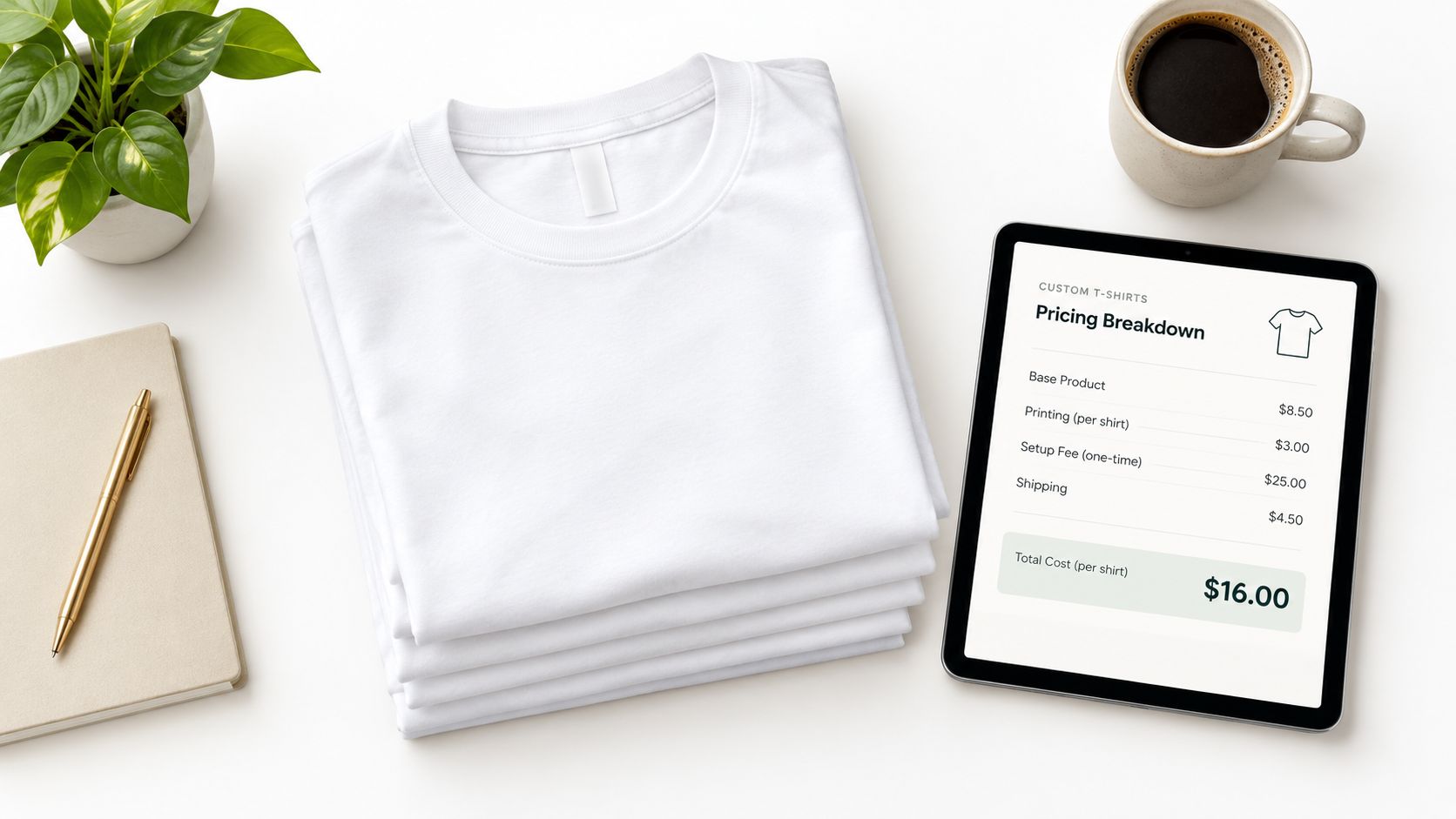
What should a custom T-shirt quote include, and which deadline can your printer meet? A useful quote separates the blank garment, decoration method, artwork preparation, print locations, and delivery requirements. Ask for that breakdown. It exposes costs hidden behind a low starting price, such as setup, extra placements, premium sizes, shipping, or rush handling.
Quantity changes the economics. One detailed shirt may suit digital printing or vinyl, while a larger identical run can make screen printing more efficient because preparation costs spread across more garments. The right crossover depends on the artwork, garment, print positions, and provider. Request two or three quantity options instead of guessing.
Understand minimums and small orders
Canada's textile printing market reached US$831.8 million in 2024 and is forecast to reach US$1,382.9 million by 2030, with a 9.0% CAGR, according to Grand View Research. The market also includes no-minimum ordering, local fulfilment, and short production options, as described on Printful's Canada custom shirts page. That page lists examples such as same-day pickup, 2–5 business day shipping after production, and in-store customisation taking about 10 minutes. Treat those as service examples, not promises for every design or supplier. Get your committed delivery date in writing.
No-minimum ordering works well for testing a new logo, replacing one employee shirt, or checking a product before a larger run. It does not automatically offer the lowest team-order price. For repeat orders, ask the printer to retain the artwork specifications and garment choice so future batches match.
Build your quote request around four questions:
- What's included: Confirm the garment, decoration, print locations, artwork preparation, taxes, shipping, and pickup terms.
- What changes the price: Ask how extra colours, individual names, dark garments, premium sizes, and multiple placements affect the total.
- What is in stock: A Vancouver shop can suggest a comparable blank when your preferred colour or size is unavailable, avoiding a long wait for stock from outside Canada.
- What date is promised: Separate proof approval, production, and transit. A shipping estimate is not a delivery commitment.
Rush orders leave little room for revisions. For a hard event date, send final artwork early, approve the mockup promptly, and choose an available garment rather than waiting for a style that must cross a border.
Local production also gives you direct quality control. You can review a sample, confirm placement, and fix a mismatch before the full order is completed. That proximity reduces lead-time risk and limits the handoffs that can create errors across warehouses and carriers.
A Step-by-Step Workflow for Local Ordering
A smooth custom apparel order starts before anyone presses “approve.” Give the printer a clear brief, keep one person responsible for final decisions, and treat the mockup as a production document rather than a decorative preview.
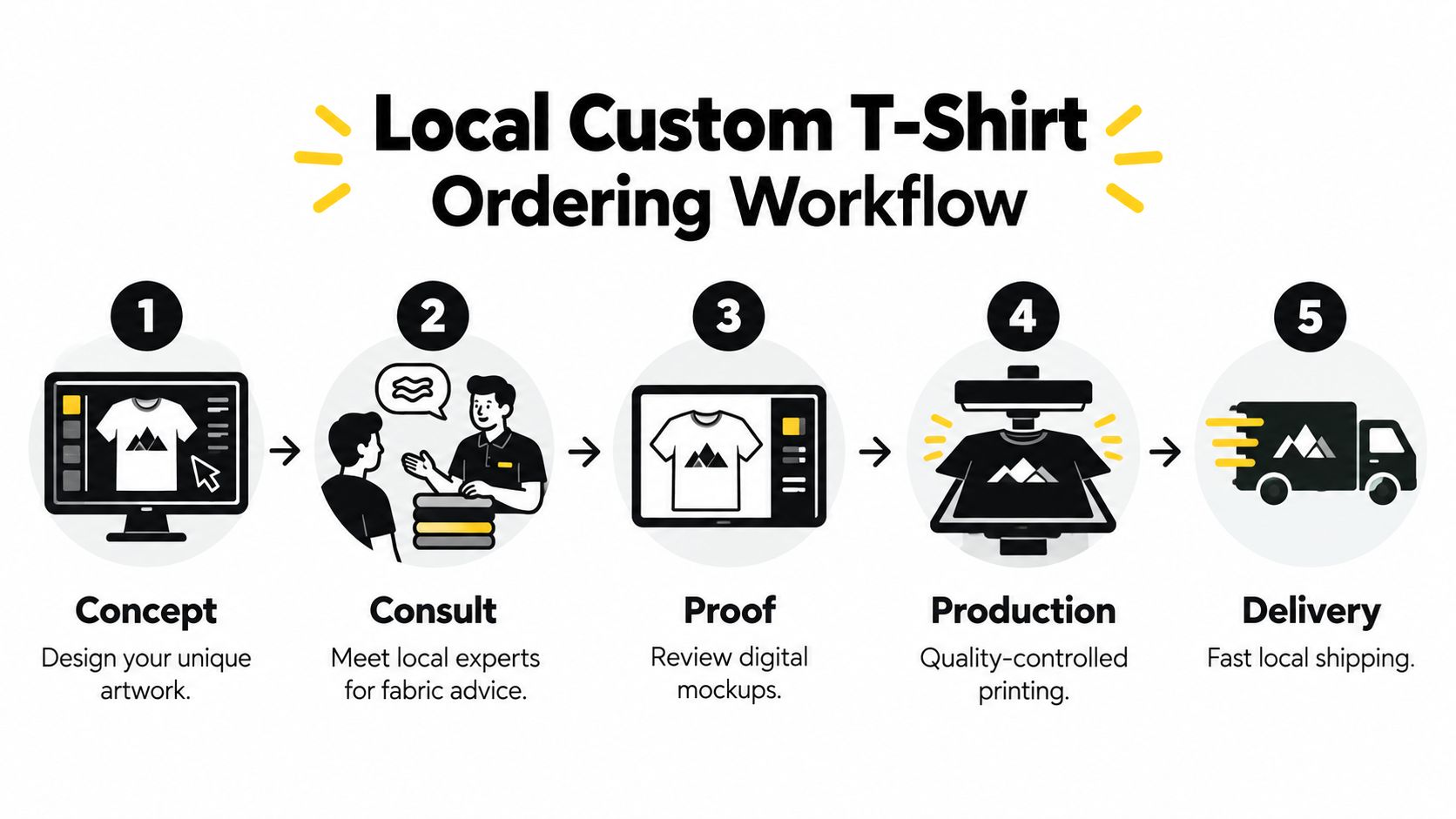
- Define the job. Write down who will wear the shirts, how often they'll be washed, where they'll be used, the target quantity, required sizes, artwork locations, and delivery date. A printer can recommend the process much more accurately with that information.
- Prepare the artwork. Send the cleanest logo file you have and identify brand colours by name or reference. If the file needs cleanup, ask for design support before requesting production. Don't approve from a low-resolution image that hides rough edges or incorrect proportions.
- Choose the garment and method together. The shirt colour, fabric, design detail, quantity, and intended use all influence the recommendation. A local decorator can point out compatibility issues before they become a failed sample.
- Review the mockup carefully. Check the print size, placement, spelling, colours, garment style, and size breakdown. Ask where the artwork will sit relative to seams, pockets, collars, and sleeve openings. This is the last easy point to change the order.
- Approve, pay, and track. Confirm the final quote and delivery terms in writing. Keep the approved mockup attached to the order record, then ask who will contact you if a garment becomes unavailable or production reveals an artwork issue.
Local communication matters most during the middle of the process. If the printer can speak directly with you about a colour shift or garment substitution, you can make a decision quickly instead of waiting through a chain of automated support messages.
Never approve a bulk run from memory. Approve the actual mockup, garment, placement, and quantities in one written record.
The Advantages of Working with a Local Vancouver Provider
Online marketplaces win on breadth. A local Vancouver printer wins where business buyers usually feel the most pressure, communication, inspection, timing, and accountability.
You can discuss the project with someone who understands the intended use, not just the uploaded file. That conversation helps uncover practical issues such as whether a construction crew needs a more resilient garment, whether an event shirt must tolerate outdoor activity, or whether a logo will lose contrast on a dark blank.
Quality control happens closer to the decision
A local provider can show you a sample, confirm the garment in person, or identify a placement problem before producing the complete order. That access doesn't eliminate every production risk, but it gives you a faster way to resolve one. It also lets you compare the hand feel, weight, and fit instead of trusting a catalogue description.
Proximity helps with urgent work too. Local production and Canadian fulfilment can reduce dependence on cross-border transit, customs processing, and distant returns. That matters in Vancouver, where a missed delivery can affect a conference, a seasonal campaign, or a crew starting a new contract.
The Canadian custom-apparel market is crowded, and local custom t-shirt printing options differ in equipment, garment inventory, decoration methods, and support. Ask whether the shop performs the relevant work directly, who approves the artwork, and how it handles a shortage or defect.
Choose a partner, not just a checkout page
For an ongoing business programme, consistency matters more than a one-time bargain. Record the approved shirt style, decoration method, artwork version, colour references, and sizing preferences. A shop that can manage printing, embroidery, and related branded merchandise under one relationship may also simplify future uniforms and event orders.
Power Print is a Vancouver, BC provider offering custom apparel decoration, including t-shirts, workwear, uniforms, printing, embroidery, and engraving, with pre-production mockup support and flexible ordering options. That model suits businesses that want local communication and a defined approval point before production.
If your next order has a hard deadline, don't start by browsing templates. Bring the logo, garment use, quantity range, and delivery date to a Vancouver printer, request a method recommendation and written quote, then approve a physical or clearly specified digital proof before production.
Power Print can help Vancouver businesses select custom t-shirts, workwear, uniforms, and promotional apparel with printing, embroidery, and pre-production mockups. Visit Power Print with your artwork and deadline to discuss the right garment, decoration method, and local delivery plan.