

Customizable Volleyball Jerseys: A Buyer's Guide to Options
You're staring at several quotes for customizable volleyball jerseys, and every vendor seems to offer another fabric, neckline, printing method, colour package, and personalization upgrade. The problem isn't a lack of choice. It's that nobody has helped you decide which choices matter for your roster, your tournament calendar, and the players who'll need replacement garments later.
For a Canadian club, the best jersey isn't the one with the longest feature list. It's the one that delivers the right comfort, fit, decoration, and reorder process without creating avoidable delays or compliance problems. Use the guide below to decide how much customization you need, rather than buying every option a supplier can sell.
Table of Contents
- What a Volleyball Team Manager Is Actually Ordering
- Fabric Choices That Hold Up on the Court
- Blanks Plus Decoration vs Full Sublimation
- Fit, Cut, and Sizing for Mixed Rosters
- Numbering, Names, and Branding Options
- Lead Times and Ordering Logistics in Canada
- Why the Most Customizable Jersey Is Not Always the Best
- Ordering Checklist for Your Next Volleyball Season
What a Volleyball Team Manager Is Actually Ordering
A volleyball jersey order is really four decisions packaged as one garment.
First, choose the fabric for the way your team plays. A recreational group attending short evening sessions has different needs from a competitive club playing several matches in an indoor tournament. Second, choose the decoration method. You might need a simple team logo and numbers, or you might want a fully printed design covering every panel.
Third, settle the fit and size system before anyone approves artwork. Women's, men's, unisex, and youth blocks don't fit the same way, and a visually perfect jersey still fails if athletes can't move comfortably through serving, blocking, and diving. Finally, define the branding package: team colours, logos, player names, numbers, sponsor marks, league identifiers, and any required labels.
Practical rule: Treat customizable volleyball jerseys as a system of trade-offs, not a menu of upgrades.
A full-sublimation jersey may give you the broadest visual control, but it can make late additions harder. A blank jersey with applied decoration may offer fewer design effects, yet it can be the safer choice when your roster changes or when you need one replacement quickly. A premium performance fabric may be worthwhile for long tournament days, while a simpler blend can suit a community team that plays less intensively.
Start your vendor conversation with these questions:
- How will the jerseys be used? Identify training, league play, tournaments, indoor climate, and expected washing.
- What must appear on the garment? Separate mandatory numbers and logos from optional names, sponsors, and decorative graphics.
- How stable is the roster? A fluid youth roster needs a different reorder strategy from an established elite squad.
- What deadline cannot move? Work backward from the first match, not from the date you hope to place the order.
That short audit prevents you from paying for visual complexity that creates more administration than value.
Fabric Choices That Hold Up on the Court
Fabric affects comfort, drying, movement, and how well the jersey survives repeated use. For volleyball, don't choose material by softness alone. A garment that feels pleasant in a fitting room can become uncomfortable during long matches if it holds moisture against the body.
Sport Information Resource Centre guidance on moisture-wicking athletic apparel explains the underlying mechanism clearly. Wicking garments use capillary action to move sweat away from the skin toward the outer surface, where it can evaporate. The benefit is most relevant during maximal or very intense exercise, while low-to-moderate activity may not create the same physiological advantage over cotton.
The three practical fabric families
Polyester blends are the sensible middle ground for many clubs. Polyester is light, durable, and commonly used for athletic apparel, while a blend can soften the hand feel or add stretch. It's a practical choice for recreational teams, school programs, and clubs that need dependable uniforms without paying for the most engineered construction.
Engineered performance synthetics earn their premium when the team plays hard and often. Channel-knit structures, mesh zones, and carefully designed synthetic blends can move moisture efficiently and reduce the saturated feeling that develops during repeated rallies. Fabric structure and fit matter as much as the fibre name, so ask for documented wicking information rather than accepting “performance fabric” as a complete specification.
Natural-fibre or hybrid blends usually feel softer, but cotton and similar fibres absorb moisture rather than moving it outward as efficiently. They can work for casual wear, team travel shirts, or short recreational sessions. They're a weak choice for multi-match tournament play, where wet fabric can feel heavy and contribute to rubbing.
| Fabric Family | Moisture Management | Durability | Feel & Weight | Best For |
|---|---|---|---|---|
| Polyester blend | Reliable for ordinary indoor play | Good with proper care | Light to moderate, often softer than pure performance fabric | Recreational teams, schools, short-format play |
| Engineered synthetic | Strong moisture movement and fast-drying potential | Designed for repeated athletic use | Light, structured, and performance-focused | Competitive clubs, long matches, tournaments |
| Natural-fibre or hybrid blend | Absorbs more than it wicks | Depends heavily on the blend | Soft, familiar, sometimes heavier when wet | Casual use, warmups, low-intensity activity |
For general apparel comparisons, the T-shirts and hoodies fabric guide can help managers think through fibre, weight, and garment-use trade-offs beyond sports uniforms.
My recommendation: Use a polyester blend for recreational and short-format play. Choose an engineered synthetic when your athletes face long matches, repeated rallies, or tight tournament schedules.
Also request wash instructions before approving the order. A technically capable fabric can still underperform if the team uses excessive heat, harsh products, or poor drying practices.
Blanks Plus Decoration vs Full Sublimation
The choice between a decorated blank and a fully sublimated jersey comes down to roster stability, design ambition, and reorder risk.
A blank jersey starts as a stocked garment. The vendor adds numbers, logos, names, or sponsor marks using a method such as screen printing, heat transfer, or another applied decoration process. Full sublimation starts with printed fabric panels, then the panels are cut and sewn into the finished jersey. That process supports edge-to-edge graphics, gradients, patterns, and broad colour coverage.
| Factor | Blanks + Decoration | Full Sublimation |
|---|---|---|
| Cost structure | Efficient for small orders and replacements | More setup and production work is built into the garment |
| Minimum order flexibility | Often better for single additions or small reorders | Usually less convenient for isolated mid-season additions |
| Design range | Strong for logos, numbers, and controlled spot-colour layouts | Best for gradients, patterns, photo-quality artwork, and full coverage |
| Reorder process | Straightforward if the blank and decoration files remain available | Requires consistent files, fabric, cut, and production specifications |
| Best fit | Small and mid-size clubs with changing rosters | Large programs and teams prioritizing a fully bespoke visual identity |
Screen printing can produce crisp, durable marks when the design uses a controlled number of spot colours. Heat-applied decoration can be useful for names and numbers when the roster changes late, but the vendor should explain the expected wear characteristics and care requirements. Sublimation puts the dye into the polyester fabric, which keeps the surface light and avoids a raised ink layer.
The key economic point is not just the initial unit price. It's the total cost of managing changes. A small club may save money by ordering a sensible blank, then adding a late player without reopening a complete garment-production cycle. A larger club with a stable roster may prefer sublimation because the design consistency and broad artwork options justify the more involved process.
For a plain-language comparison of decoration methods, review this guide to DTF, screen printing, DTG, and sublimation.
Verdict: Blanks plus decoration win for small and mid-size clubs that value flexibility. Full sublimation wins for large programs, elite clubs, and teams that want photo-quality artwork across the entire jersey.
Don't choose sublimation just because it looks more advanced. Choose it when your design and programme structure will use what it does best.
Fit, Cut, and Sizing for Mixed Rosters
Fit problems create more complaints than colour problems. Start by separating the garment blocks your roster needs. Women's, men's, unisex, and youth cuts distribute fabric differently across the shoulders, torso, waist, and arm openings.
A single unisex template can leave a tall teenage athlete feeling boxed in across the shoulders while giving another player too much room through the torso. For mixed-gender or youth-adult clubs, a parallel women's and men's order is usually more comfortable and more professional than forcing everyone into one block.
Common design choices include:
- Classic crew neck: Familiar, stable, and easy to standardize across a club.
- Slight V-neck: Gives a less enclosed feel without creating a deep opening.
- Deep V-neck: Offers a sharper athletic look, but requires careful checking around modesty and layering.
- Two-button henley: Adds a distinctive uniform detail, though the placket can change the feel around the chest.
- Racerback or cap sleeve: Useful for women's teams seeking more shoulder clearance, but confirm that the cut suits the club's comfort and coverage policies.
- Long sleeve: Provides additional coverage for players who prefer it, but check whether the sleeve interferes with the intended fit during overhead movement.
Sleeve length matters less than shoulder construction and armhole shape. A cap sleeve can feel freeing for spiking, while a poorly cut arm opening can restrict movement regardless of sleeve length.
For sizing, use the vendor's current chart and fit samples. Don't rely on the size label from a previous supplier, because blank patterns can shift between manufacturers. Keep the approved chart, garment style, and measurement notes on file so replacement orders don't become guesswork.
| Cut | Neckline/Sleeve | Best For | Watch Out For |
|---|---|---|---|
| Unisex crew | Crew neck, standard sleeve | Simple mixed orders | Can fit shoulders and waists unevenly |
| Women's athletic | Crew, V-neck, cap sleeve, or racerback | Women's and youth-girls programmes | Check torso length and arm opening |
| Men's athletic | Crew or V-neck, standard sleeve | Men's and broader-shouldered athletes | Avoid overly loose torso blocks |
| Long sleeve performance | Crew or V-neck, long sleeve | Players wanting added coverage | Confirm mobility and cuff comfort |
Numbering, Names, and Branding Options
Numbers should be planned before the artwork is approved because placement affects seams, logos, sponsor blocks, and readability. Sublimation prints the number into the fabric, so the surface remains light and there's no separate layer to lift. Applied numerals, including screen-printed or tackle-twill versions, add texture and can be less forgiving under repeated diving and washing.
Use conventional placements unless your league specifies otherwise. A small front number usually sits on the chest, while the back number needs to be large enough for officials and spectators to read. Sleeve numbers can help in some competition formats, but they add another placement to proof and another area to keep clear of seams.
Names deserve an earlier decision than many managers expect. An arched name across the upper back gives a traditional team appearance. A straight name looks cleaner and is simpler to align. Omitting names can be the better choice for recreational leagues with frequent roster changes, especially when you want to avoid replacing a complete garment because one player leaves.
Sponsor marks need their own hierarchy. A dominant sponsor logo can compete with the player number, while a tiny logo becomes difficult to reproduce or read. Choose the decoration method based on location and material:
- Heat-transfer vinyl: Fast and economical for simple marks, but confirm durability before using it for high-contact areas.
- Embroidered crest: Gives a premium, dimensional appearance, though it can feel stiff on lightweight polyester.
- Sublimated sponsor block: Clean and integrated, but it works best when the entire jersey uses a compatible sublimation process.
Canadian labelling requirements also belong in the specification sheet, not in a last-minute delivery conversation. The Textile Labelling and Advertising Regulations require approved fibre names and fibre-content disclosure for textile products sold in Canada. For a Vancouver-based buyer, request the exact fibre percentages, compliant label copy, and care instructions before production.
Compliance checkpoint: Ask for bilingual English and French labelling details and confirm how the vendor will handle country-of-origin information before the order is approved.
That discipline helps procurement teams compare suppliers on actual material specifications instead of vague performance language.
Lead Times and Ordering Logistics in Canada
Lead time starts when the artwork, sizes, quantities, and payment details are approved. It doesn't start when a manager first emails a logo.
Canadian vendors commonly advertise domestic production windows of about three to four weeks, about four weeks, or about six weeks depending on the garment and process. Canadian custom-uniform turnaround examples show why you should compare the promised timeline, approval stage, and delivery location rather than copying a number from a product page.
Use this sequence for planning:
- Mockup request: Send the logo files, colours, garment cuts, quantities, names, and numbers together.
- Proof approval: Check front, back, sleeves, sponsor placement, spelling, number assignments, and label information.
- Production: The vendor prepares blanks or prints and assembles the garments.
- Inspection: The team should verify decoration, sizing, quantities, and visible defects before distribution.
- Delivery: Build in time for shipping exceptions and any required correction.
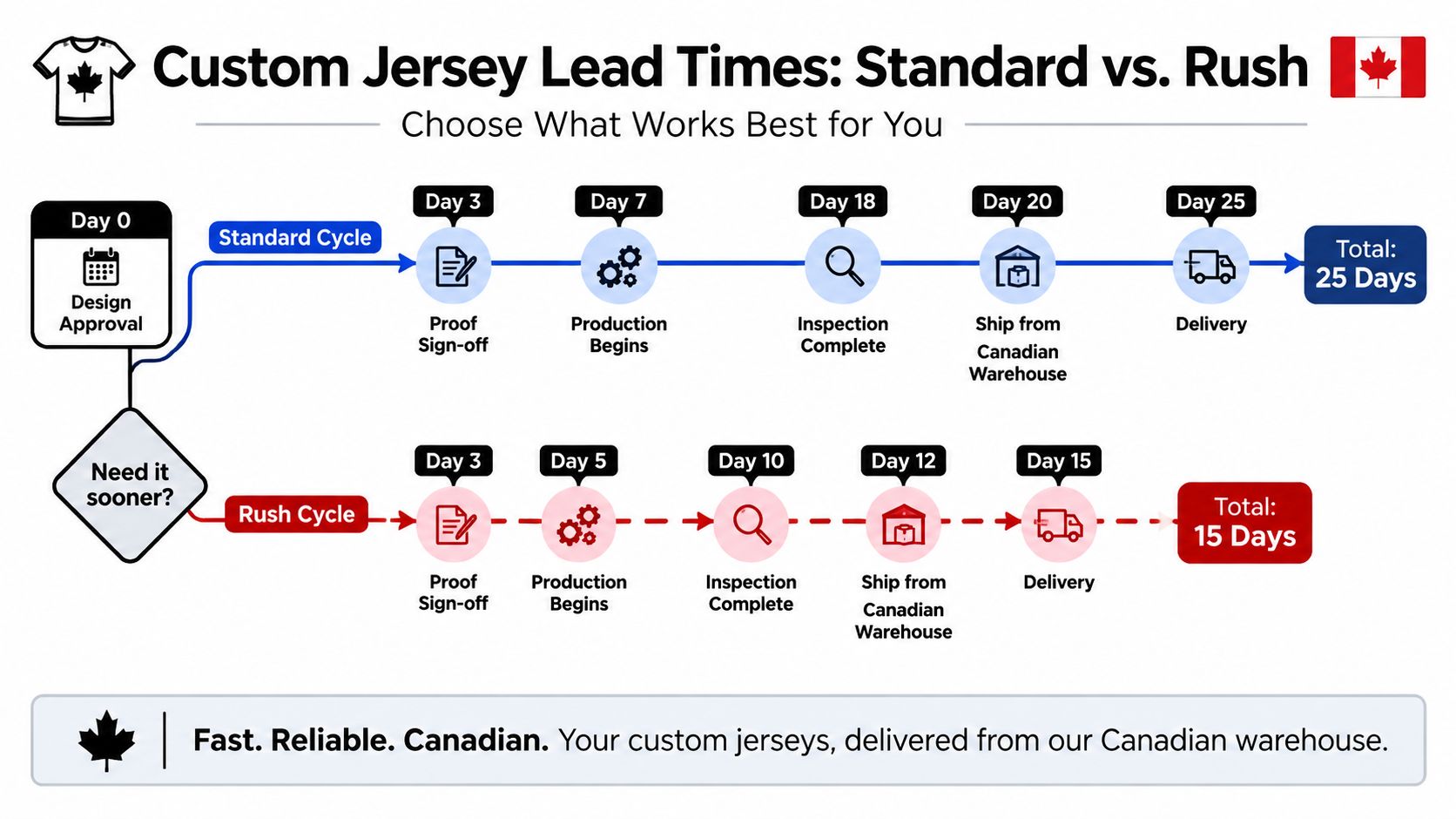
The practical deadline is your first tournament or league match, minus enough time to inspect the shipment and solve a problem. If a vendor offers rush production, ask exactly what gets compressed and what doesn't. Rush service may require locked artwork, final sizing, and complete payment before production begins, and it won't rescue a roster that keeps changing.
Canadian buyers should also ask whether the quoted price includes shipping, applicable taxes, brokerage, and any cross-border handling. Imported uniforms can create extra charges that aren't obvious in the garment quote. One consolidated club shipment is usually easier to track and administer than several staggered deliveries, particularly when separate freight and handling charges apply.
Ordering rule: Set an internal proof deadline before the vendor's production deadline. Late approvals are the most common source of avoidable pressure.
If you want a vendor to price the full project with quantities, decoration, and timing included, use a detailed custom apparel quote request rather than asking for a generic jersey price.
Why the Most Customizable Jersey Is Not Always the Best
More customization creates more places for a team to make an expensive decision. Every extra colour, panel, logo, name treatment, and garment block needs approval. If the roster changes after production, the team may also need to recreate a highly specific garment instead of ordering a straightforward replacement.
A simpler template often wins in three situations:
| Scenario | Better Choice | Why It Wins |
|---|---|---|
| Under-15 club with a fluid roster | Stock blank with two-colour decoration | Late additions and replacements are easier to manage |
| First-year programme testing sponsor revenue | Controlled design with limited decoration | The club can validate sponsor placement before committing to a complex identity |
| Coach expects colour or branding changes each season | Repeatable blank-based system | The next order won't depend on one elaborate production file |
Fully bespoke work can also carry hidden costs, including artwork revisions, setup work, minimum-order requirements, and garments that become unusable when a player leaves. Those costs matter more for a small programme than for a large club with stable quantities and a dedicated administrator.
The marketing phrase “unlimited customization” sounds attractive, but unlimited options don't solve a team's operational problem. A manager usually needs correct sizes, legible numbers, consistent branding, dependable delivery, and a reorder path. A restrained design can deliver all five more reliably than a complicated layout.
The better question is not “What can we add?” It's “Which addition helps the team enough to justify the cost and future administration?”
Treat customization as a budget allocation problem. Spend first on fabric, fit, number readability, accurate proofs, and delivery certainty. Add visual complexity only after those foundations are secure.
Ordering Checklist for Your Next Volleyball Season
Bring this list to the vendor consultation. If your team can answer each item, the quote should be clearer and the proofing process should move faster.
Roster and sizing
- Quantity: Confirm the full player count, coaching requirements, spare garments, and likely additions.
- Size breakdown: Use the vendor's measurement chart and approve sample garments before finalizing the run.
- Names and numbers: Decide whether every jersey gets a name, numbers only, or a mixed approach.
- Garment blocks: Identify women's, men's, unisex, and youth cuts before artwork is locked.
Design decisions
- Colour system: Supply approved colour references and identify the primary and secondary colours.
- Decoration method: Ask whether the proposal uses sublimation, screen printing, heat transfer, or another process.
- Placement map: Approve front, back, sleeve, and sponsor locations visually.
- Artwork files: Provide clean, editable logo files and confirm which graphics need rebuilding.
Branding and compliance
- Sponsor approval: Get written approval for sponsor logos before production.
- Number readability: Check contrast from normal viewing distance and confirm league requirements.
- Fibre details: Request exact fibre composition, care instructions, and bilingual Canadian label copy, consistent with the Canadian textile labelling rules.
- Replacement policy: Ask how the vendor handles a single damaged or late-added jersey.
Logistics timing
- Roster lock: Set a firm internal deadline before production begins.
- Proof approval: Assign one person to approve the final mockup so conflicting feedback doesn't delay the order.
- Delivery address: Confirm the complete shipping address and a receiving contact.
- Inspection plan: Schedule time to check quantities, spelling, sizes, decoration, and defects before distribution.
Ask the vendor whether reorders retain the same blank, artwork, colour references, and number style. That answer tells you more about long-term suitability than a glossy mockup.
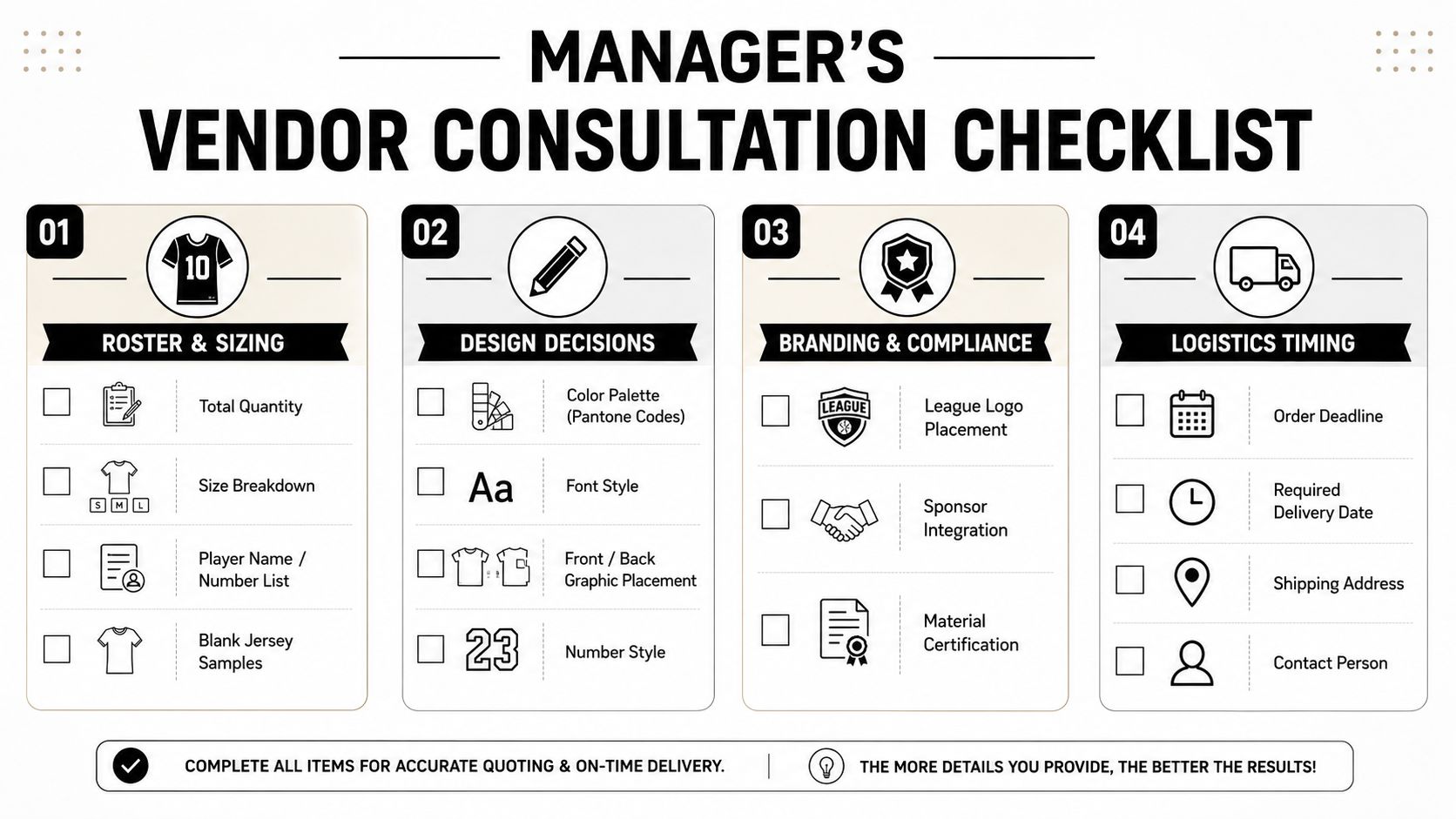
Screenshot summary: Choose the use case, lock the fit, select the decoration method, confirm bilingual labelling, approve one final proof, and order early enough to inspect the shipment.
Power Print helps Vancouver teams compare printing, embroidery, and athletic-apparel decoration without forcing a small club into an oversized order. Visit Power Print with your roster, artwork, deadline, and preferred jersey style, and request a mockup and quote built around the customization you'll use.